Concrete Driveway Installation and Replacement in Brentwood, CA
What a new or replacement concrete driveway involves, what drives the price, and what a good quote should include, for homes in Brentwood and East Contra Costa.
Short answer
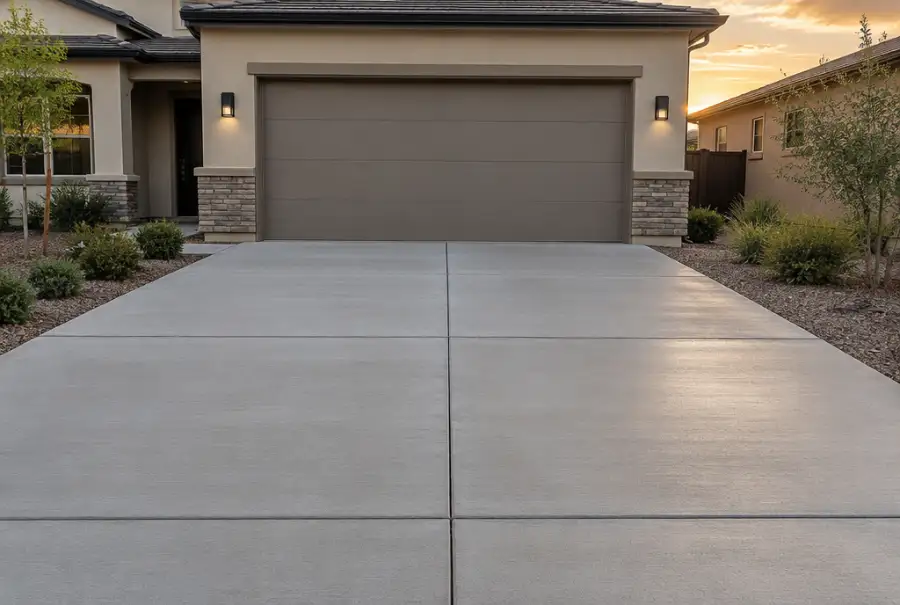
A replacement driveway means removing the old slab, preparing and compacting the base, setting forms and reinforcement, pouring at least 4 inches of concrete for cars, cutting control joints and letting it cure. Expect about a week before light traffic. For planning, poured concrete driveways run roughly $6 to $25+ per square foot installed, depending on thickness, base work, finish and access.
The numbers a good driveway quote should mention
A complete quote states each of these. They are where cheap and good driveways differ.
- 4 inMinimum thickness for standard vehicles; 5 to 6 in for heavy onesHomeGuide
- ≤ 15 ftMaximum control-joint spacing, and 24 to 36 times the slab thicknessNRMCA CIP 6
- ¼ depthMinimum depth of a sawcut joint, cut 4 to 12 hours after finishingNRMCA CIP 6
- 7–10 daysBefore light traffic; full cure takes about 28 to 30 daysHomeGuide
What a driveway replacement involves
A quote for a new or replacement driveway should cover the same basic steps. If a quote skips one, ask why.
- Demolition and haul-off. Breaking out the old slab and removing it. Removal adds roughly $1 to $6+ per square foot, so it should show as its own line.
- Grading and base. Shaping the ground so water runs away from the house and garage, then placing a compacted base.
- Forms and reinforcement. Setting the edges and placing rebar or wire mesh. Rebar adds roughly $1 to $3+ per square foot.
- Pour and finish. Placing the concrete, then finishing the surface (broom, smooth, salt or exposed aggregate).
- Joints and curing. Cutting control joints and protecting the slab while it cures.
Thickness, reinforcement and joints
HomeGuide says a driveway for standard vehicles should be at least 4 inches thick, with 5 to 6 inches for heavy vehicles. A Bay Area contractor guide gives the same 4-inch standard and the same 5 to 6 inch range for heavier traffic. The quote should state the thickness, the reinforcement type and the control-joint layout. Control joints are cuts that tell the slab where to crack, and a driveway can still crack between them.
Joint layout matters as much as thickness. Industry guidance keeps joints no more than 24 to 36 times the slab thickness apart (no more than 15 feet), cuts them at least a quarter of the slab deep, and keeps panels close to square (NRMCA). A joint-layout sketch makes this easy to check.
What Brentwood conditions mean for your driveway
- Clay ground that moves with moistureThe Brentwood soil series is named for this area. USDA describes it as a clay loam with roughly 35 to 40 percent clay and moderately slow permeability, and classifies its clay as smectitic (USDA), the type that swells when wet and shrinks as it dries (background). Soil varies lot to lot, so ground preparation and compaction under the slab or pavers matter.
- Long, hot pour seasonBrentwood's hot season runs from about early June to early October, with July highs averaging 90°F (Weather Spark). Hot, dry, windy weather speeds evaporation and raises the risk of early shrinkage cracks, which is why the concrete industry advises avoiding the hottest part of the day, dampening the subgrade and curing the slab properly (NRMCA). Pour timing and curing should be part of the plan.
- The apron and sidewalk are yours to maintainBrentwood's code makes the owner next to a sidewalk responsible for repairing it, and counts the curb, parking strip and driveway approach as part of the sidewalk, except damage caused only by city-planted trees (BMC 12.12.010). Work in the public right-of-way needs an encroachment permit from the city engineer (BMC 12.08). If your project touches the apron, curb or sidewalk, the permit should be part of the job; the City of Brentwood has the details.
Finishes
A broom finish is the common plain option. Colored concrete, exposed aggregate and stamped patterns cost more and have their own upkeep. Stamped and exposed aggregate driveways cost more than a plain broom finish; plan on roughly $7 to $25+ per square foot. If you are weighing stamped work, read the stamped concrete page and the honest pros and cons.
How long until you can use it
HomeGuide lists an initial set in 24 to 48 hours, light traffic after about 7 to 10 days, and a full cure around 28 to 30 days (HomeGuide). Follow your contractor's instructions on when to walk on it, when to park, and when to seal.
Widening or extending an existing driveway
Adding width or length to an existing driveway is a different job from a full replacement. The new concrete has to tie into old concrete, and color and finish may not match perfectly. Plan how the new section will meet the old one. Check your HOA rules before changing the footprint. Widening at the street usually means changing the driveway approach, which in Brentwood sits in the public right-of-way and needs an encroachment permit (BMC 12.08).
Repair or replace?
Not every cracked driveway needs replacing. Our repair and resurfacing guide explains what patching and overlays can and cannot fix.
What changes the price
Square footage, demolition, base preparation, thickness, reinforcement, finish, access for equipment, slope and any steps or aprons all move the total. A 400 square foot, two-car driveway can run roughly $2,400 to $10,000+. The concrete cost guide shows more sizes.
Before you request quotes
- Measure length and width, or tell us the rough size
- Note whether the old driveway is concrete, asphalt or pavers
- Make sure the quote itemizes demolition, base, thickness and reinforcement
- Check each license at cslb.ca.gov
Sources
- HomeGuide — Concrete Driveway Cost (Jun 3, 2025)
- Angi — Concrete Driveway Cost (Apr 16, 2026)
- Cardona Construction — How Much Do Concrete Driveways Cost in the Bay Area? (contractor guide) (Jan 5, 2026)
- NRMCA — CIP 6, Joints in Concrete Slabs on Grade (accessed Oct 2026)
- NRMCA — CIP 12, Hot Weather Concreting (accessed Oct 2026)
- USDA NRCS — Official Soil Series Description: Brentwood series (accessed Oct 2026)
- Wikipedia — Expansive clay (accessed Oct 2026)
- Weather Spark — Climate and average weather year round in Brentwood, California (accessed Oct 2026)
- Brentwood Municipal Code — Chapter 12.12, Sidewalk maintenance (accessed Oct 2026)
- Brentwood Municipal Code — Chapter 12.08, Street encroachments (accessed Oct 2026)
- CSLB — Homeowner Checklists (accessed Oct 2026)
Common questions
How much does a concrete driveway cost?
For planning, roughly $6 to $25+ per square foot installed, so a 20x20 (400 sq ft) driveway can run about $2,400 to $10,000+. A written quote after measuring gives the actual price. The concrete cost guide shows common sizes.
How thick should a concrete driveway be?
HomeGuide says at least 4 inches for standard vehicles and 5 to 6 inches for heavy vehicles. A good quote states the thickness and the reinforcement in writing.
How long before I can drive on a new concrete driveway?
HomeGuide lists an initial set in 24 to 48 hours, light traffic after about 7 to 10 days, and a full cure at 28 to 30 days. Your contractor will give specific instructions for your mix and the weather.
Can I just repair my driveway instead of replacing it?
Sometimes. Minor flaking or hairline cracks can often be patched or resurfaced, while large cracks, crumbling or settling usually point to replacement. See the repair and resurfacing page.
Request a concrete or paver quote
Tell us what you're planning. You'll get a call back to talk through the project and set a time to measure.
- Send the short form or call. Project type, rough size and your city are enough.
- Talk it through. A local concrete and paver pro calls to ask a few questions about the job.
- Get a written quote. After measuring, the contractor gives you a written price. No obligation to hire.