Paver Driveway Installation in Brentwood, CA
A paver driveway is interlocking units over a compacted base. Here is what separates a good install from a bad one, and what a good quote should include.
Short answer
A paver driveway lasts as long as its base. Industry guidance calls for at least 6 inches of compacted aggregate base for a residential driveway on well-drained soil, about 1 inch of bedding sand, and edge restraints, with thicker bases or a geotextile on clay or wet ground (CMHA). For planning, installed paver driveways run roughly $10 to $45+ per square foot.
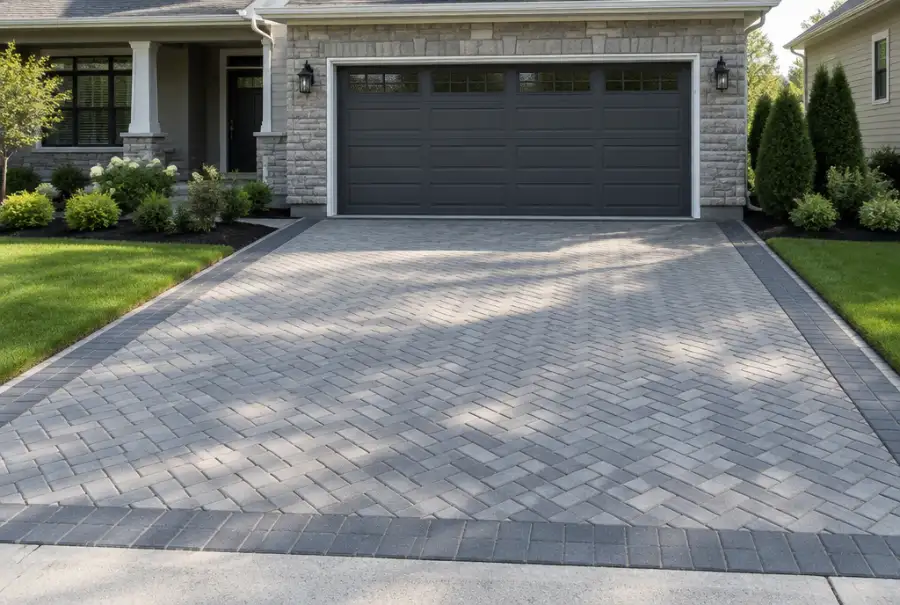
What to see written into a paver driveway quote
- 6 in min.Compacted base for a residential driveway on well-drained soilCMHA
- ~1 inBedding sand, spread and screeded before the pavers go downCMHA
- Clay soilCan call for a thicker base or geotextileCMHA
- $10–$45+Paver driveway, per sq ft, planning rangeInstalled
What a paver driveway is
A paver driveway uses interlocking concrete or clay units set on bedding sand over a compacted aggregate base, held in by edge restraints, with sand swept into the joints. The units spread vehicle loads across the base, so the base does most of the structural work.
Base depth is the quality question
HomeGuide lists 4 to 6 inches of base for pedestrian areas and 6 to 12 inches for driveways. Base depth and material, compaction and how the edges are held tell you more about a paver driveway than the paver brand does.
The Concrete Masonry & Hardscapes Association gives a minimum of 6 inches of compacted base for residential driveways and 4 inches for patios and walks, both over well-drained soil, with about 1 inch of bedding sand. It allows geotextile over clay and moist silty soils and calls for thicker bases on weak or wet soils (CMHA). Brentwood's namesake soil is a clay loam, so a base deeper than the minimum may be needed on your lot.
Brentwood conditions that affect paver driveways
- Clay ground that moves with moistureThe Brentwood soil series is named for this area. USDA describes it as a clay loam with roughly 35 to 40 percent clay and moderately slow permeability, and classifies its clay as smectitic (USDA), the type that swells when wet and shrinks as it dries (background). Soil varies lot to lot, so ground preparation and compaction under the slab or pavers matter.
- Wet winters on slow-draining soilMost rain falls between early October and mid-May, with February the wettest month (Weather Spark). On clay that drains slowly, slope away from the house and a sound base matter. Paver guidance allows a geotextile over clay and calls for thicker bases on weak or wet soils (CMHA).
- The apron and sidewalk are yours to maintainBrentwood's code makes the owner next to a sidewalk responsible for repairing it, and counts the curb, parking strip and driveway approach as part of the sidewalk, except damage caused only by city-planted trees (BMC 12.12.010). Work in the public right-of-way needs an encroachment permit from the city engineer (BMC 12.08). If your project touches the apron, curb or sidewalk, the permit should be part of the job; the City of Brentwood has the details.
Paver types
Concrete pavers are the most common, with clay brick, natural stone and porcelain as other materials. Installed paver driveways run roughly $10 to $45+ per square foot for planning. Thickness matters for vehicle loads, so the quote should list the paver thickness.
Permeable pavers
Permeable pavers have wider joints filled with stone to let water pass through. Permeable systems usually cost more than standard pavers. We make no claims about local stormwater rules or rebates. Check with your city whether anything applies to your property.
Upkeep: joints, weeds and sealing
Pavers are low maintenance but not no maintenance. HomeGuide notes periodic weeding of seams (HomeGuide), and sand in the joints may need topping up. Sealing is optional and adds cost. Sealing runs roughly $1 to $4+ per square foot (HomeGuide).
Repairs
Individual pavers can be lifted and re-laid, which HomeGuide describes as cheaper and easier than repairing or replacing a concrete surface (HomeGuide). A settled area usually means the base needs attention, not just the pavers.
What changes the price
Excavation and base depth, paver type, pattern complexity, borders, edging, access and drainage all move the total. Excavation or removal of an old surface adds roughly $1 to $6+ per square foot. See the paver cost guide for worked examples.
Compare before you decide
Weighing pavers against a poured driveway? Read the concrete vs pavers guide and the concrete driveways page. Hiring? Use the paver contractor checklist.
Sources
- HomeGuide — Paver Patio Cost (Sep 18, 2024)
- HomeGuide — Pavers Cost Per Square Foot (Apr 24, 2023)
- HomeGuide — Cost of Pavers vs. Concrete (May 30, 2025)
- Concrete Masonry & Hardscapes Association — Construction of Interlocking Concrete Pavements (PAV-TEC-002) (accessed Oct 2026)
- USDA NRCS — Official Soil Series Description: Brentwood series (accessed Oct 2026)
- Wikipedia — Expansive clay (accessed Oct 2026)
- Weather Spark — Climate and average weather year round in Brentwood, California (accessed Oct 2026)
- NRMCA — CIP 12, Hot Weather Concreting (accessed Oct 2026)
- Brentwood Municipal Code — Chapter 12.12, Sidewalk maintenance (accessed Oct 2026)
- Brentwood Municipal Code — Chapter 12.08, Street encroachments (accessed Oct 2026)
Common questions
How much does a paver driveway cost?
For planning, roughly $10 to $45+ per square foot installed, so a 20x20 (400 sq ft) paver driveway can run about $4,000 to $18,000+. A written quote after measuring gives the actual price.
How deep should the base be for a paver driveway?
HomeGuide lists 6 to 12 inches of base for driveways, against 4 to 6 inches for pedestrian areas. A good quote states base depth and material in writing.
Are pavers cheaper than concrete?
Usually not up front: roughly $10 to $45+ per square foot for a paver driveway against $6 to $25+ for poured concrete. Pavers can be repaired one unit at a time, which may matter over the years.
Do pavers settle or sink?
They can if the base was not deep enough or well compacted, or if drainage fails. That is why base depth and compaction are the main quality questions.
Request a concrete or paver quote
Tell us what you're planning. You'll get a call back to talk through the project and set a time to measure.
- Send the short form or call. Project type, rough size and your city are enough.
- Talk it through. A local concrete and paver pro calls to ask a few questions about the job.
- Get a written quote. After measuring, the contractor gives you a written price. No obligation to hire.